By Alicia Erickson, Epicure & Culture contributor
It began with a sunset hunt on the Savannah.
A piercing “kaw kaw!” echoes across the expansive plains.
Perched in the thorny branches, arrow-marked babblers begin to sound alarms, signaling to herds of zebra and antelope the presence of predators:
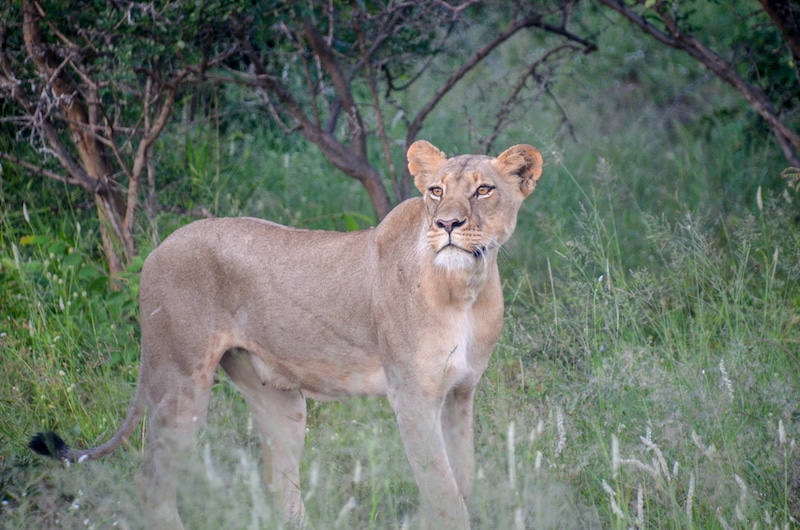
Two hungry lionesses.
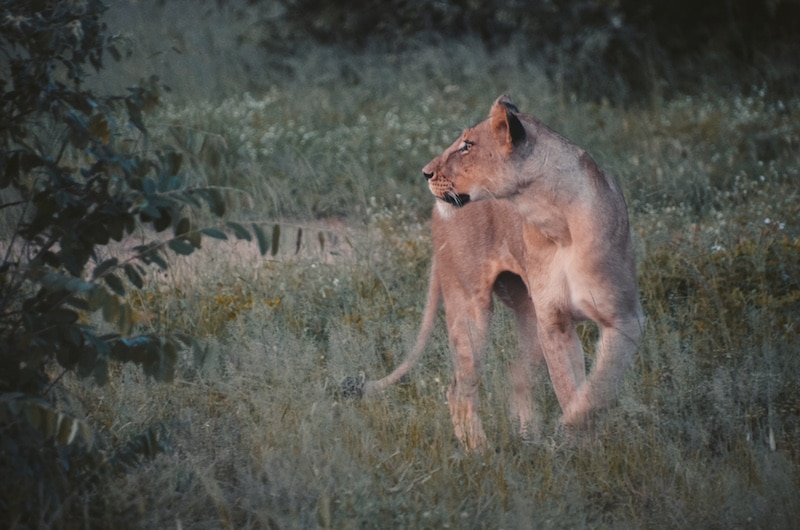
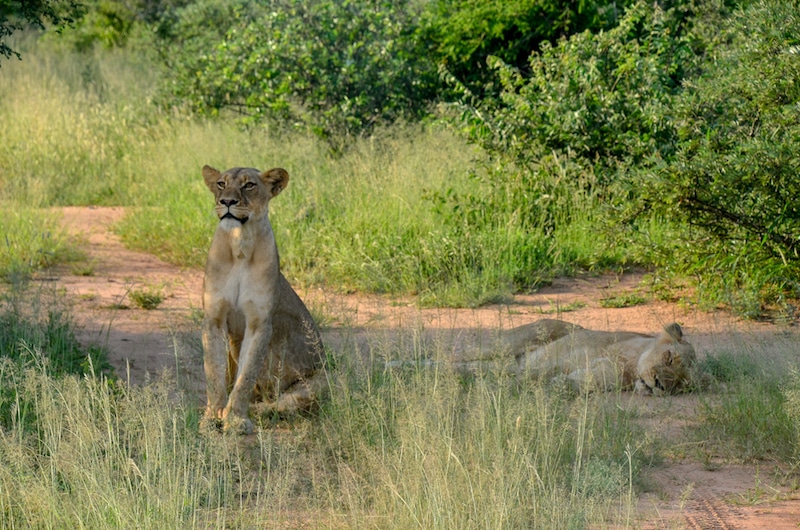
The two cats— mother and daughter—slowly prowl through the veld, their sand-colored coats camouflaged against the dry brush.
Dozens upon dozens of zebra, kudu, and wildebeest, grazing on vegetation, suddenly stop in their tracks.
Recognizing the familiar call of the bird, they are now aware of the danger upon them.

Lion hunts are never a short or swift affair.
Many laws of nature are working against this predator, as all of their potential prey work together to protect one another.
The lionesses lay low, their amber eyes speckled with the sun’s reflection, awaiting any sign of movement.
Life in South Africa’s Makalali Conservancy stands still as time passes by.
The sky gradually becomes tinged with the first hint of dusk.
With night quickly approaching, the lionesses need to make a move soon if they want dinner to bring home to their pride tonight.
Suddenly, chaos breaks out as birds start madly calling.
The younger lioness has finally pounced.
The air is thick with dust as antelope and zebra frantically leap across the grassy plains.
Shrill, hectic cries ring from zebras.
Part of their herd is left behind.
Hooves kick up dirt as kudu fly through the air in a mad attempt to escape the hungry jaws of the lioness.
And as suddenly as it started, everything stops.
The savannah is suddenly silent and still again.
Although fast, lions lack duration. The potential prey has escaped unscathed for now.
The two lionesses rest in the grass without a kill. Defeated, they wander over to a pond to drink water before disappearing into the approaching night.
And we, the three visitors in the savannah, drive back to the grounds of Little Garonga camp, stunned by the wild and unpredictable beauty of Makalali.
The Difference Between Game Reserves And National Parks
Safari destinations, national parks, lodges and game reserves in South Africa abound.
So much so that it makes it difficult to know where to go and where to stay.
Kruger National Park in Limpopo Province welcomes over 1.5 million visitors annually. Hluhluwe-Imfolozi National Park in Kwa-Zulu Natal receives a fraction of the numbers of Kruger but is still much more crowded than private reserves.
South Africa also boasts dozens of private game reserves much smaller in size and geared towards wildlife protection and repopulation.
The wildlife is in abundance with an intimacy not found in major national parks.
Without compromising the diversity of flora and fauna, such conservancies offer premiere safari experiences free from lines of cars.
At times, the private reserves are free from any other tourist sightings entirely.
[socialpug_tweet tweet=”Here is why you should consider visiting a private game reserve vs a national park when going on #safari in #SouthAfrica ” display_tweet=”Here is why you should consider visiting a private game reserve vs a national park when going on #safari in #SouthAfrica “]
Psst, don’t forget to pin this post for later!
Sustainable Tourism In South Africa: Eco-Friendly Safari Lodging
A rising trend for South Africa tourism is five-star luxury in the national parks; however, with that label often comes high-speed Wi-Fi, TVs in rooms, and modern architecture, detracting from the parks’ natural habitats.
Such lodges not only contradict the concept of escaping into nature, which is at the very heart of a safari, but they also intrude on the environment, contributing to a carbon footprint and potentially threatening the eco-system.
To counter that trend, the country has also seen the recent development of small-scale, eco-friendly lodges and sustainable South African retreats that offer guests an experience reminiscent of classic 1950’s style bush camps.
Built with natural materials that do not harm the existing eco-system, running primarily on solar power, and filtering rainwater are among the green policies these lodges are adopting.
And to go a step beyond, they encourage disconnection from technology to fully engage with the landscapes and wildlife.
Visiting The Makalali Conservancy In Limpopo Province
Makalali Conservancy is located west of the well-known Kruger National Park in Limpopo Province of northeastern South Africa.
Surrounded by 26,000 hectares (64,247 acres) of grasslands and home to thousands of animals and only a handful of bush camps, Makalali offers an intimate alternative to the tourist-flooded Kruger.
At about a five-hour drive from Johannesburg or a 1.5-hour drive from Hoedspruit, where daily flights arrive from Cape Town and Johannesburg, the reserve offers a highly accessible safari opportunity.
With only a limited number of camps in Makalali, tourists are few and far between, minimizing the footprint on the environment and maximizing the interaction with wildlife.
For instance, Garonga, which has two neighboring sites within the reserve — Little Garonga and Garonga Safari Camp — offers sustainable, five-star facilities, a personalized experience, and a wide range of activities introducing guests to the best of Makalali.
A Garonga Safari: Luxury & Sustainability in the Bush
I had been on my South African safari at Makalali Conservancy for a mere six hours prior to the lion hunt, arriving to Little Garonga Camp’s intimate three-chalet compound in the late morning.
Deep in the heart of Makalali, a few sand-colored mud structures rise above the bush.
Garonga captures the essence of a traditional bush camp, complimenting the best of what Makalali has to offer:
A return to small-scale, low-impact safaris that offer full immersion into the South African wild.
Sustainability is at the forefront of Garonga’s intentions.
Solar power is provided by onsite panels, which supply about 30% of Garonga’s power needs.
Food and natural waste are transformed into natural gas, which is then used for cooking.
Grey water is processed through a filter system before returning to a watering hole for animals.
One can expect to dive deep into the best of Makalali during a stay at Garonga.
A wooden yoga shala built beneath the shade of trees overlooks the bushveld.
Excursions to sleep in the bush or partake in the star bath are arranged to venture even deeper into the reserve.
For wildlife encounters, daily game drives take place at sunrise and sunset led by guides working closely with conservation and rehabilitation in Makalali.
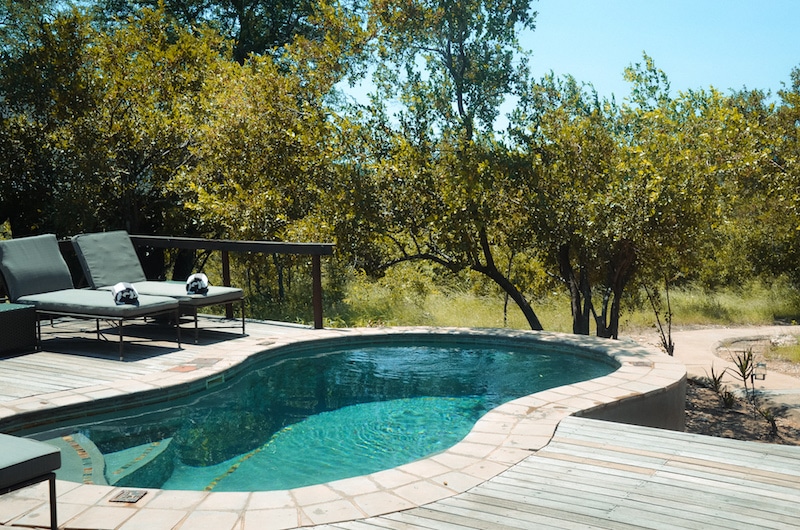
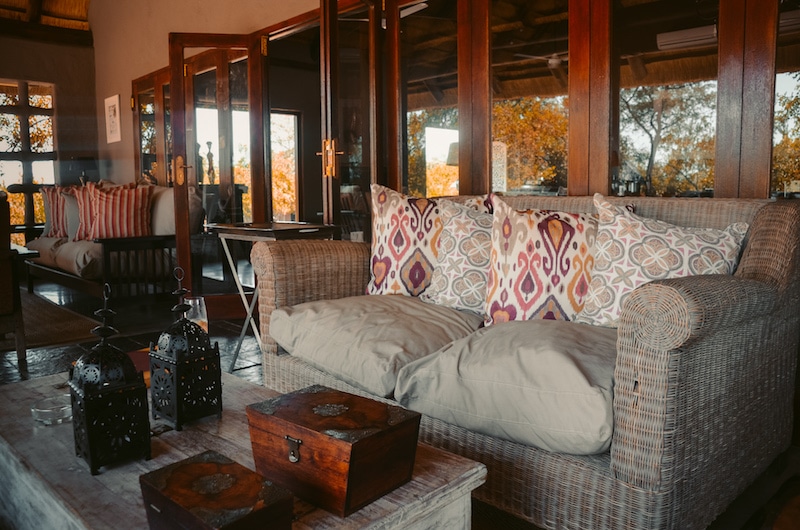
For time to simply enjoy the peace of Makalali, an outdoor patio is decorated with cushy furniture and a swimming pool ideal for cooling off in while watching life in the veld pass by.
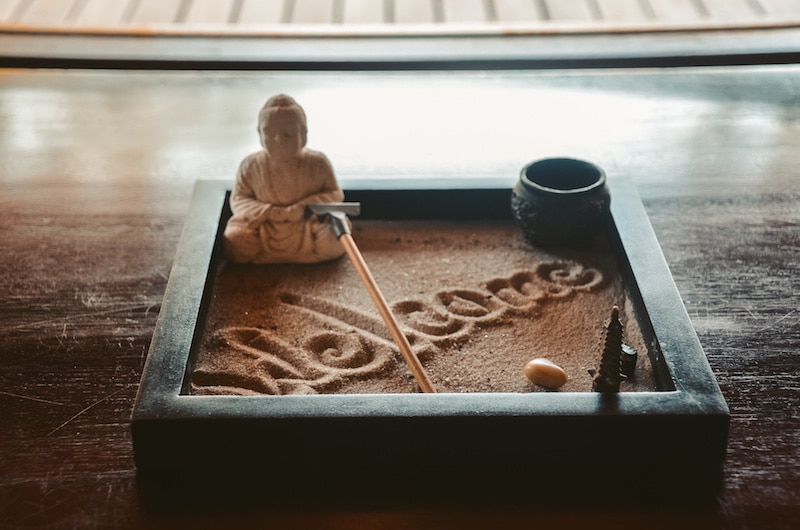
On each table, one finds a small sandbox with simple sayings, adding to the Zen atmosphere Garonga has so carefully curated.
With a glass of some of South Africa’s finest chenin blanc wine in hand, I pass the afternoon in the hammock on the deck of my chalet, overlooking the expanse of the reserve.
Sunrise & Animal Tracking in Makalali
Despite my temptation to linger in the comforts of my chalet, waking up with the sunrise is truly the best way to beat the heat and catch prime animal viewing opportunities.
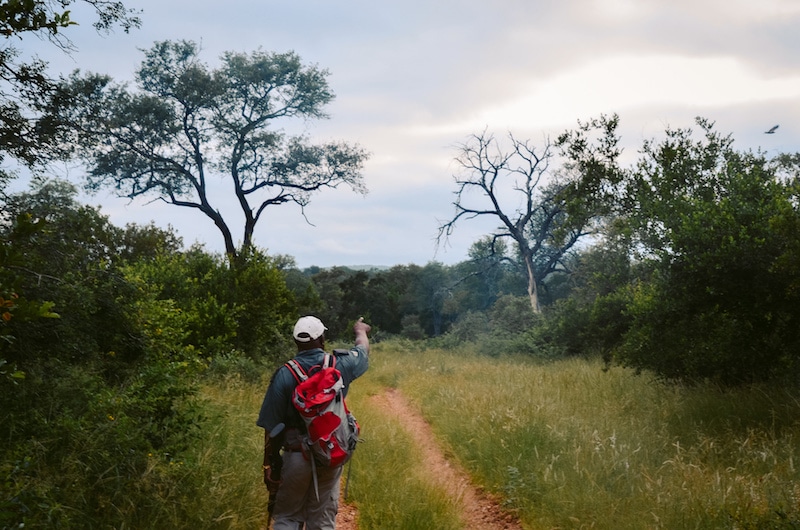
On my first morning, I join Garonga’s veteran tracker, Jeff, on a bush walk.
By going on a walking safari, one has a greater opportunity to catch the sights and sounds missed when on a game drive.
Within a few steps, Jeff points down to tracks in the dirt:
“Here, you can see zebras just passed by and crossed into the field on the left.”
By observing patterns and directions of the prints, trackers learn to detect where animals are within the reserve.
I find a vulnerability in walking through the same territory in which large mammals roam.
Yet, there is also a meditation in the bush walk. Without the noise of the vehicle, I am privy to the subtle sounds around me:
The rustle in the grass, the calls of birds.
We frequently stop to identify tracks, where Jeff tests my knowledge.
And I fail almost every time to match the tracks with the animal. Tracks in the dirt appear much smaller than I expected!
Jeff stops periodically to explain the names of bushes and plants, to tell stories of jackalberry and marula trees.
Marula fruits, sweet and yellow when ripe, are used to make a local brew.
The jackalberry tree, with a thick trunk reaching high into the sky, bears purple fruit favored among many species, including the jackal, after which the tree was named.
Eventually, we descend down into a dry riverbed, which just the week before was full of water.
Based on the direction in which the grass is pressed against the creek wall, we can determine which direction the water was flowing.
Knowledge such as this is helpful for survival in the bush.
Encounters With Cheetahs In South
As we continue our walk, Jeff receives a call on the radio:
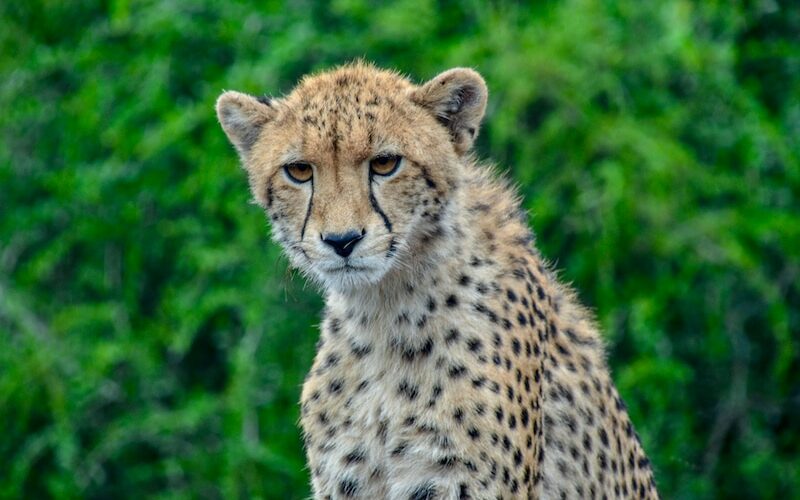
The female cheetah has been spotted!
We hurriedly walk towards a pickup place and hop into the vehicle, which drives in search of our anticipated cat.
Never having seen a cheetah in the wild, I am giddy with anticipation.
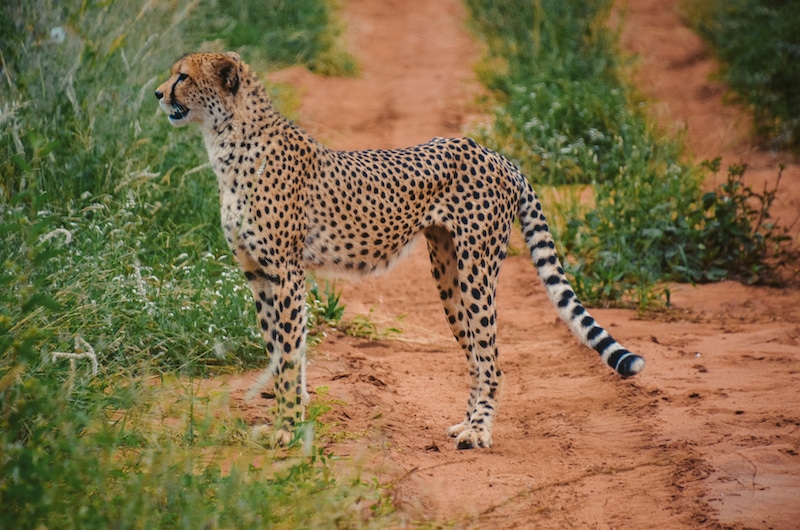
After just a few minutes of driving, we find her strolling up and down the perimeter of a fence.
She is much smaller than I anticipated. Her slim body looks almost fragile among the expanse of the bush.
Although known to be the fastest land animals, cheetahs are, in fact, relatively weak in comparison to other predators.
We spend the remainder of our drive with the cheetah until she disappears into the plains.
After returning from the game drive and sufficiently overeating Little Garonga’s sumptuous breakfast of cheese, fresh fruits, and smoothies, I move to Garonga’s Safari Camp, just a few minutes walk away.
[socialpug_tweet tweet=”Kruger National Park isn’t the only place to safari in #SouthAfrica! Check out these unforgettable sustainable #safaris located in less-frequented places. ” display_tweet=”Kruger National Park isn’t the only place to safari in #SouthAfrica! Check out these unforgettable sustainable #safaris located in less-frequented places. “]
Experiencing Garonga Safari Camp
Garonga Safari Camp hosts guests in six luxury tents with decks that open up to a riverbed, offering uninterrupted views over the plains.
Located just below the lounge is an infinity pool, which is perfect for peering into the bush and watching elephants graze from marula trees.
And if you’re as lucky as I am, you might get to meet the elephant that visits the camp. He frequents the pool and walks right past my tent one morning.
The sun moves in the late morning and is there to stay, so I spend the better part of my day relaxing and enjoying the many views and lounges of Garonga.
I happily partake in their hand-picked selection of some of South Africa’s most delectable wines and spirits, taking time to appreciate the surroundings of Garonga before heading off for another game drive.
Awaiting guests at Garonga Safari Camp that evening is a blazing fireplace and a boma-style dinner.
A family table is decorated with greenery aglow beneath the soft flicker of candlelight, offering multi-course meals inspired by local South African cuisine.
The slow pace of life in Garonga is rejuvenating and the wildlife encounters addicting, enticing visitors to return to its abode time and again. It is hands down one of the best safaris in South Africa.
Beyond Imfolozi: Into Manyoni Reserve
Shortly following my excursion to Makalali, I set out to explore South Africa’s KwaZulu-Natal Province (KZN) on South Africa’s east coast.
Manyoni Private Game Reserve is Makalali’s equivalent in KZN:
A more intimate safari experience as an alternative to the frequently visited Hluhluwe–iMfolozi Park.
Manyoni neighbors Hluhluwe–iMfolozi and offers 23,000 hectares (56,834 acres) of some of Zululand’s best, uninhibited scenery.
With only eight lodges on the reserve, visitors are at a minimum.
After departing Durban, I continue driving on a more or less continuous highway for a few hundred kilometers, the car hugging around corners and heading into the depths of KZN’s rich, green mountains.
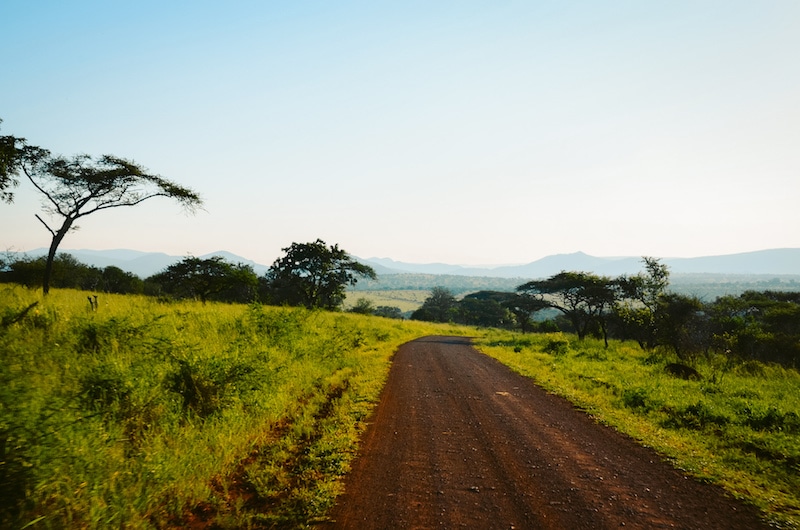
Once I bypass Hluhluwe town, the road turns to dust for the remainder of the drive.
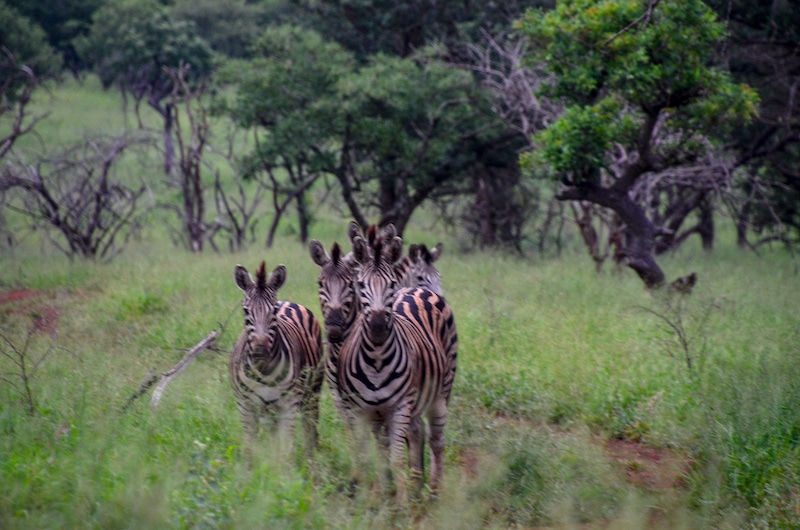
Within minutes of driving along the rich red roads, zebras and warthogs begin to pass in front of my car.
In this corner of the world, borders between nature and people fade away.
Welcome To Rhino Sands Safari Camp
After successfully meandering through the maze of dirt roads, I arrive at the subtly-marked Rhino Sands Safari Camp, hidden in the depths of the opulent riverine forest.
For travelers seeking an intimate, environmentally-friendly lodge that echoes the feeling of being at home, Rhino Sands is the place to be.
The lodge is comprised of only four luxury tents in an effort to maintain its intimacy. Additionally, the open-air canvas walls of the camp are connected by wooden walkways suspended in the forest.
At all times, one is privy to the tangle of trees and songs of the birds.
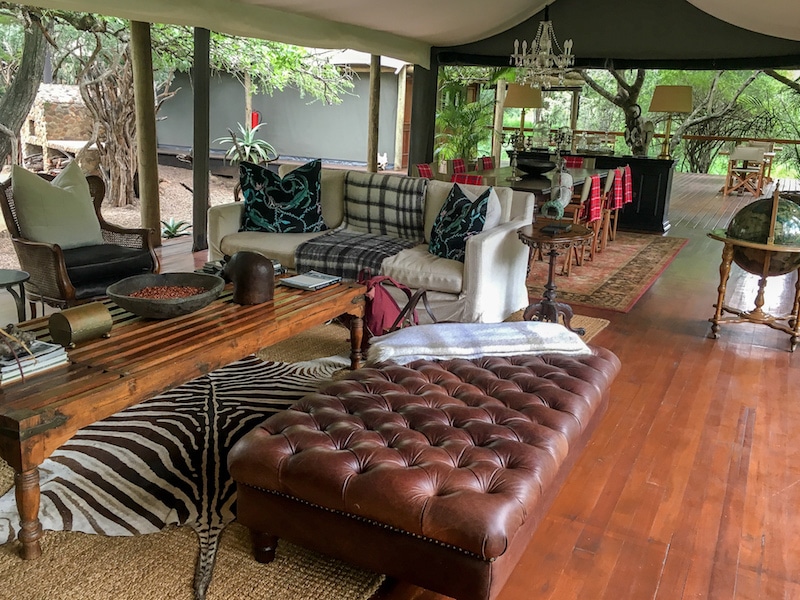
A long wooden platform has been constructed into Rhino Sand’s chic dining and common area, lavishly decorated with collections of artifacts from around the African continent.
Each detail of the design and implementation of the lodge reflect a dedication to nature.
Although the owners, Shannon and Dale Airton, are rhino conservationists by profession, they have crafted an aesthetically-pleasing, warm, and eco-conscious lodge that far exceeded all my expectations.
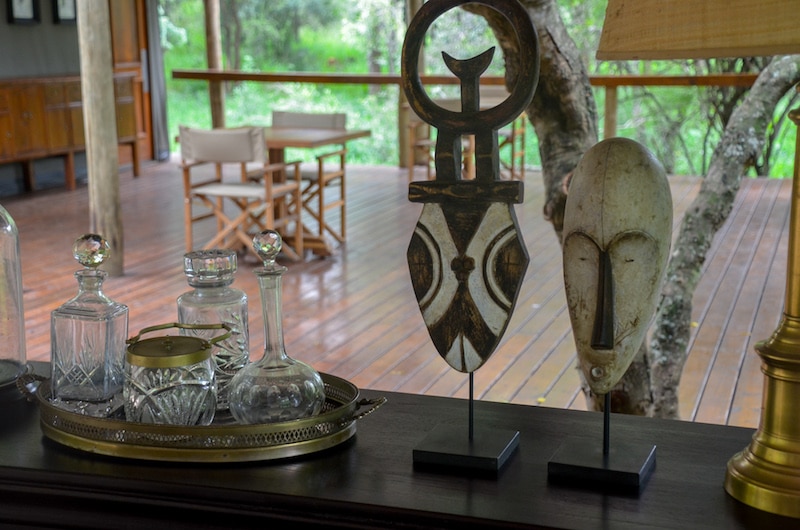
After being utterly stuffed with a lunch of fish tacos and wine from one of my favorite organic Cape wineries, Nitida, I retreat to my tent, where I spend the afternoon lounging in the private pool on my deck.
An Exciting Sunset Game Drive In Manyoni Private Game Reserve
The sun is still blazing hot as we set off for our sunset game drive.
Within minutes of setting out, a male elephant brushes past our car.
He takes his time grazing on marula fruit from nearby trees.
Not long after, the bull steps in front of our safari vehicle and continues to slowly saunter down the road.
We are stuck behind the bull, moving at a snail’s pace beneath the intensity of the late afternoon sun.
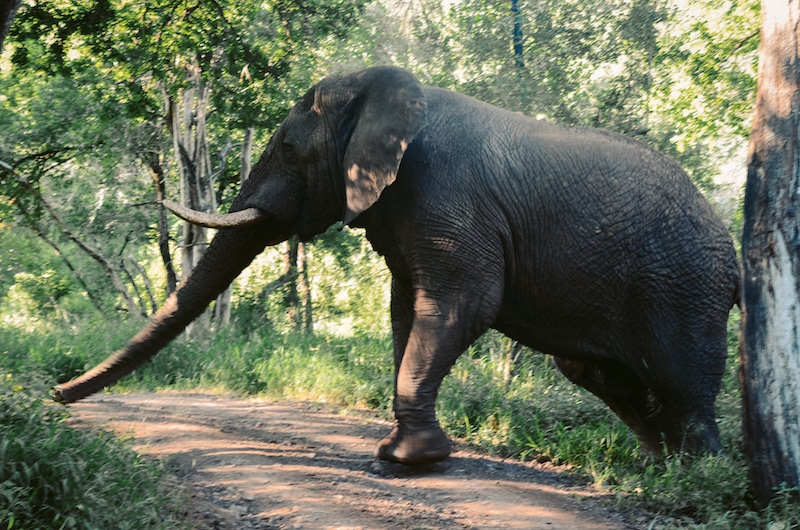
In the bush, the elephant has command of the road.
They are very territorial and given their size and strength, can choose to overturn a vehicle if aggravated.
The bull stops periodically in search of afternoon snacks and to cool off in the pools of water collected on the road.
We are going nowhere fast.
Louis, our expert field guide, relays his love for elephants, an animal that is often feared and mislabeled as being dangerous.
While territorial, elephants are also highly intelligent animals that are very in tune with human emotions.
As the sun sets beneath the hills of Manyoni, our beloved elephant walks into the bush, while we continue on our way.
With dark settling in, the creatures of the night start to emerge.
The shiny eyes of bush babies reflect from tree branches.
We drive past an African wild dog lying in the middle of the road.
High up in the trees owls silently stare back at us.
[socialpug_tweet tweet=”What has been your favorite #wildlife experience when traveling? Here is ours! #thisissustainable” display_tweet=”What has been your favorite #wildlife experience when traveling? Here is ours! #thisissustainable”]
South African Safaris: Evenings In Manyoni
Rhino Sands provokes an unquestionable feeling of being at home.
As we return to the camp for dinner, the guests share a meal with lodge staff over wine and candlelight.
The chef at Rhino Sands has accomplished perhaps the most delectable cuisine I’ve had the pleasure of indulging in at a bush camp. Complex courses of sea bass and lamb, of chutneys, creamy mashed potatoes, and grilled vegetables, give way to decadent lava cakes.
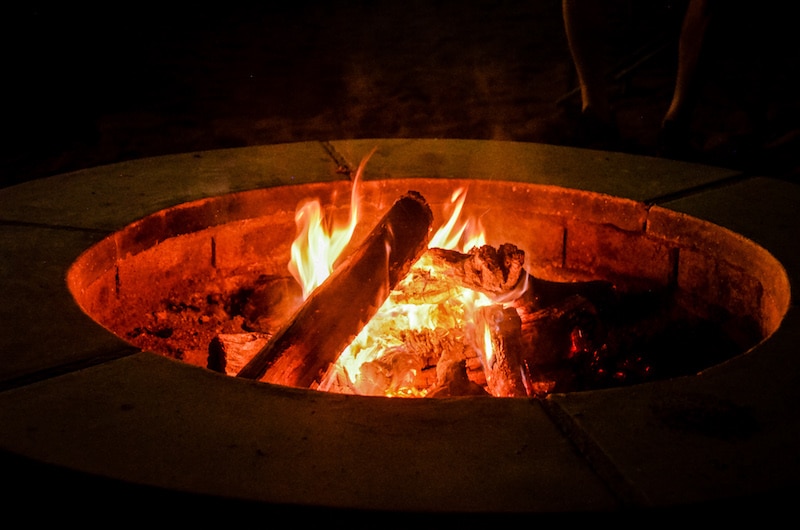
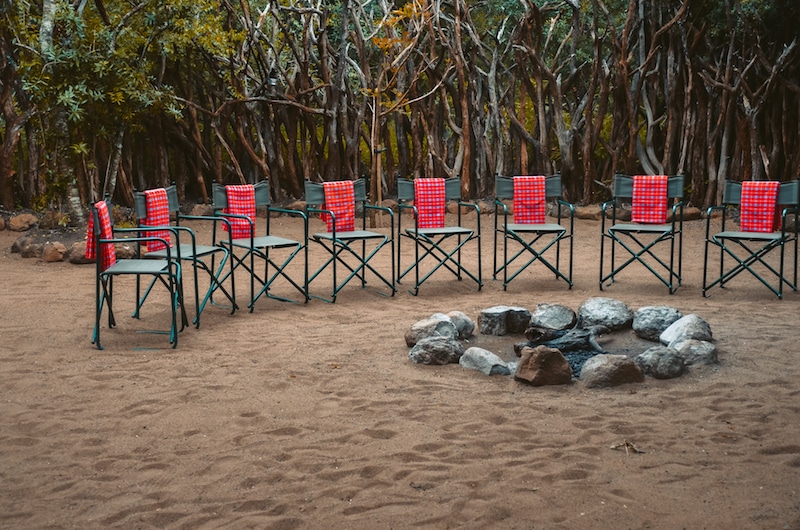
As dinner concludes, we move to the fire to indulge in the tranquility of Manyoni nights.
Thanks to the intense sun during the day, we are privy to a perfectly clear night sky, which weighs heavy with some of the Southern Hemisphere’s most spectacular stars.
I drink wine and stare up at the sky long into the night until eventually the clouds move overhead, signaling a long overdue bedtime.
A Sunrise Game Drive In Manyoni Private Game Reserve
Hesitant to leave the comforts of my tent the next morning, the gentle chorus of crickets and the promise of a morning rich with wildlife viewings stir me awake.
Setting off for our sunrise drive, we hope to avoid bush traffic this time around.
The fresh morning air sweeps through the grass and the open-air Land Rover, as life in the mountains starts to rise for the day.
Within minutes, we find our first viewing of the day:
A field full of white rhinos, more than I can count. With an increasingly high extinction rate, rhinos are often a rare sighting.
Being the namesake to Rhino Sands and at the heart of the work of the lodge’s owners, I am thrilled to spot well over a dozen.

The impetus behind the creation of Manyoni in the first place was the protection of rhinos.
Today, the reserve is part of the WWF Black Rhino Range Expansion Project.
In an effort to reduce poaching, Rhino Sands partakes in a de-horning policy, which is executed in a way that does not harm the rhinos and reduces the allure of rhinos to potential poachers.
We drive up and down curvaceous hills, with expansive views of emerald mountains teasing us in the distance.
A lilac breasted roller spans its wings and takes flight, turquoise and lavender flashing before us.
And then from above the trees, we see slow movement:
A family of giraffes grazing on treetops for breakfast. For as tall as they are, giraffes blend in well to the landscape.
Before too long, we stop for a morning coffee.
Hoping that we aren’t in lion territory, I jump out of the vehicle, eager to step foot onto the open plains.
The coffee is a warm welcome to the chilled morning, a surprising change in temperature to the day before.
And for a South African twist on coffee, I add a splash of amarula, a South African liquor from the fruit of the marula tree.
Meeting Manyoni’s Cheetah Family
As we start our drive back to Rhino Sands, we come across a rare sighting:
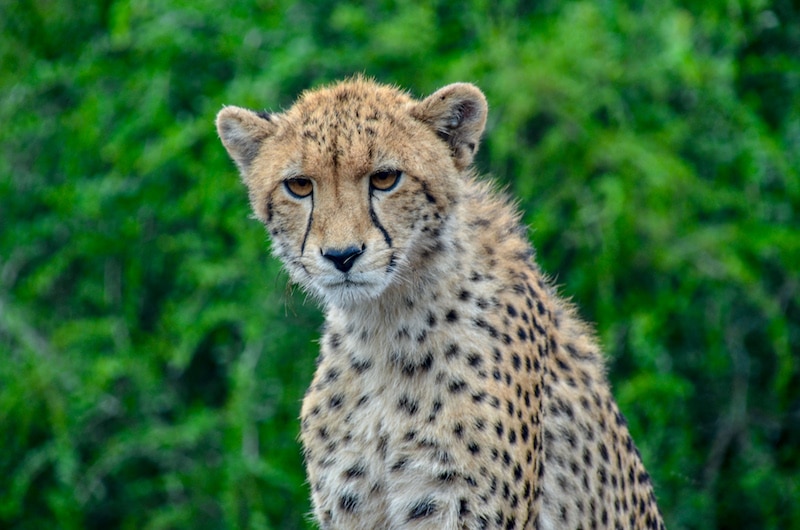
A mother cheetah and her five teenage cubs lounging on small mounds of dirt.
As our car approaches slowly, the cheetahs do not flinch, impervious to their spectators.
“She is a new mother,” Louis informs us. “She has done a fantastic job raising her cubs. All of them have survived almost to hunting age. Often, entire litters of cheetah cubs can die.”
Despite being a predator in the bush, cheetah cubs are the prey of many other predators, including lions, hyenas, and large eagles.
Two cubs cradle in a dip in the hill.
Another two playfully wrestle one other.
A couple of the cats, so relaxed in our presence, lazily gaze at us, as if posing for photos.
I could happily pass hours observing the patterns of the cheetah family, but alas, the heat of the day is encroaching.
Soon most of Mayoni’s creatures will be sleeping, so it is time to return to Rhino Sands.

[socialpug_tweet tweet=”How adorable are these cheetahs? #SouthAfrica truly offers an incredible #safari experience!” display_tweet=”How adorable are these cheetahs? #SouthAfrica truly offers an incredible #safari experience!”]
Sustainability & Conservation At Rhino Sands Safari Camp
As I sit down with Shannon, who owns Rhino Sands with her husband Dale, over a breakfast of salmon and avocado benedict, it is evident that although she has shifted her focus towards tourism in recent years, conservation is still her biggest concern.
From curating a wine list from South African wineries with environmentally-friendly policies to using bedding from eco-friendly, local South African designers, the intention is clear:
Support local businesses and minimalize environmental impact.
Rhino Sands is the only lodge in Manyoni that runs entirely off the electrical grid, using solar installations as a source of electricity.
Food menus are seasonal, coffee and teas are organic, and amenities are biodegradable.
Sustainable and conscious tourism is woven throughout the ethos of Rhino Sands without compromising comforts.
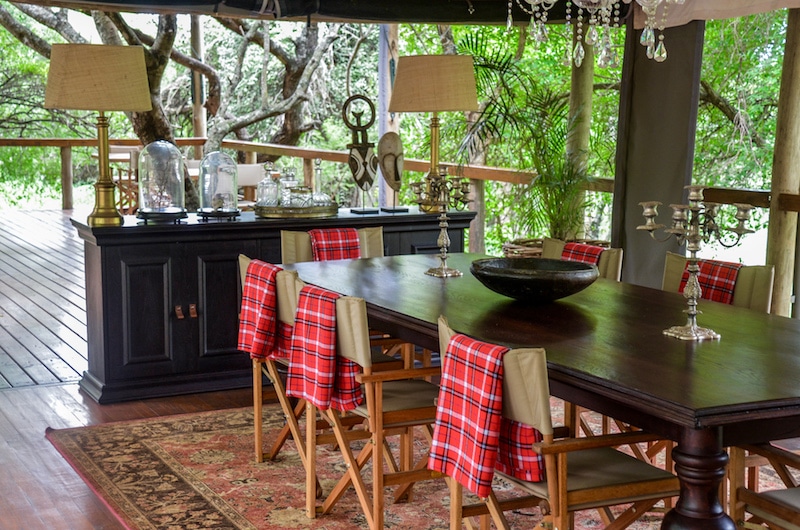
Rhino Sands has already achieved so much since its opening in 2017 with much more to follow.
I envision the lodge being a perfect destination in which to host a retreat:
Writing, painting, yoga, or whatever sparks one’s creativity inspired by the rhythm of Manyoni’s wild and the mission of Rhino Sands.
And for now, it is simply an idyllic hideaway in the heart of Manyoni, catering to human and animal guests alike.
In terms of sustainable tourism in South Africa, what are your favorite low-impact safaris?
Enjoyed this post? Pin it for later!