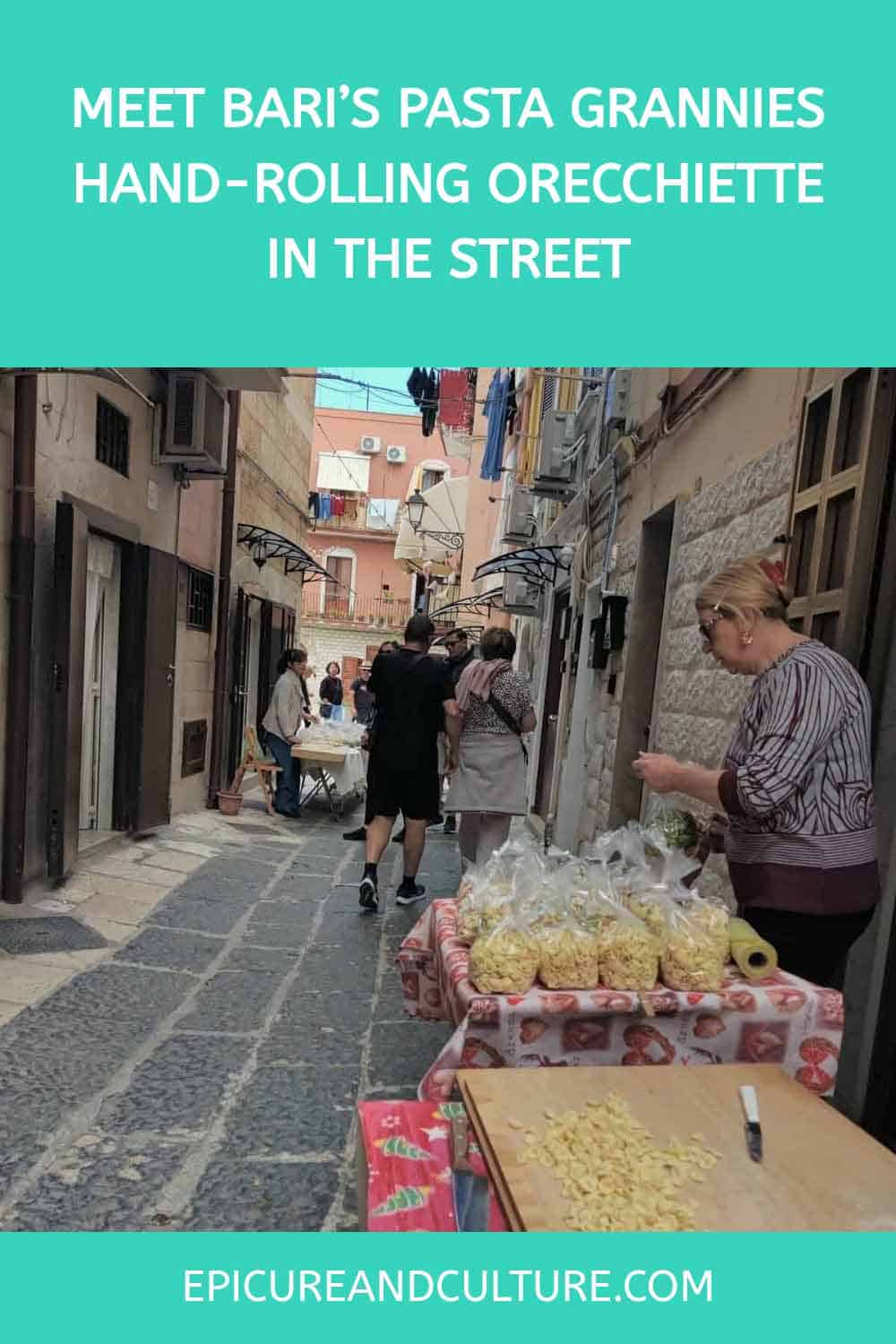

If you walk into Bari’s Old Town early in the morning, you’ll find wooden boards balanced on doorsteps and women sitting on low stools, rolling dough into tiny ear-shaped pasta.
There’s a rhythm to it: the shaping with the knife, the tap of fingers, the murmur of neighbors chatting across the lane.
Known to visitors as the pasta grannies of Bari, here, they’re simply neighbors keeping up a routine that never stopped, making hundreds of orecchiette every day on their doorsteps.
I came upon this sight in Bari when I happened to book a hotel right on Strada delle Orecchiette (Orecchiette Street), where the pasta grannies make and sell their pasta, waking up to the sounds of chatter and tables of pasta being set up at 8 am.
This made me curious to learn more — about the pasta itself, the women who still make it by hand, and how this quiet daily routine became one of Bari’s most recognizable traditions.
In this guide, we’ll look at what orecchiette really is, who the women on Strada delle Orecchiette are, how locals eat it at home, and how you can best experience it as a visitor.
🍝 Quick tips: To experience the pasta grannies of Bari for yourself:
Hotel: La Casa delle Tradizioni on Orecchiette Street
Tour: People of Bari Unusual Guided Tour with Pasta Making with a Grandma
Cooking Class: Traditional Focaccia & Orecchiette Workshop
Bari Vecchia: Where Tradition Lives in the Street
Bari Vecchia, the city’s old town, feels more like a small village than the capital of southern Italy. Lanes are barely wide enough for a scooter, and everyone seems to know each other.
Kitchens here are small and dark, so families often prepare food outside. The streets get lots of natural light, and you can feel the sea breeze drift through.
What we as visitors see as a charming street scene is really just common sense that never disappeared with modernization.
Where in other destinations something like this might feel like a show for tourists, you can tell nobody’s performing; they’re just getting on with the day, making and arranging the pasta.

Orecchiette: Puglia’s Most Famous Pasta
So what exactly is this pasta? Orecchiette are small, ear-shaped pasta from the southern Italian region of Puglia, especially around Bari.
The word literally means “little ears” in Italian. They’re made simply from durum-wheat semolina and water (no eggs), which gives them a firm, slightly rough texture that holds sauce really well.
Orecchiette has been part of life in Bari for centuries. Some trace it back to the Middle Ages, when this part of Puglia was ruled by a French dynasty. A similar pasta called crozets existed in Provence, and the idea likely traveled south through trade and migration.
But Bari made it its own. Local families began shaping the dough differently: rolling it thinner, using a blunt knife, and flipping to form the ear-like shape. This, they say, resulted in a sturdier shape perfect for sauces.
Speaking of, orecchiette is typically served with sauces made from local produce, such as olive oil, greens, and tomatoes—whatever’s in season, depending on the time of year. The lack of egg makes it hold its shape longer in hot weather, which matters in southern Italy.
Every family has a slightly different technique. Some roll wider dough strips, others smaller. The differences are minor, especially for visitors to Bari like me, but locals can tell their subtle variations apart.
In Bari, orecchiette is an everyday staple, cooked when family visits or simply when you’re craving something familiar. Its simplicity is, in fact, what makes it so loved.

The Pasta Grannies Who Roll
No Puglia itinerary would be complete without heading to Bari and visiting the Strada delle Orecchiette, where the city’s women roll pasta by hand right outside their homes.
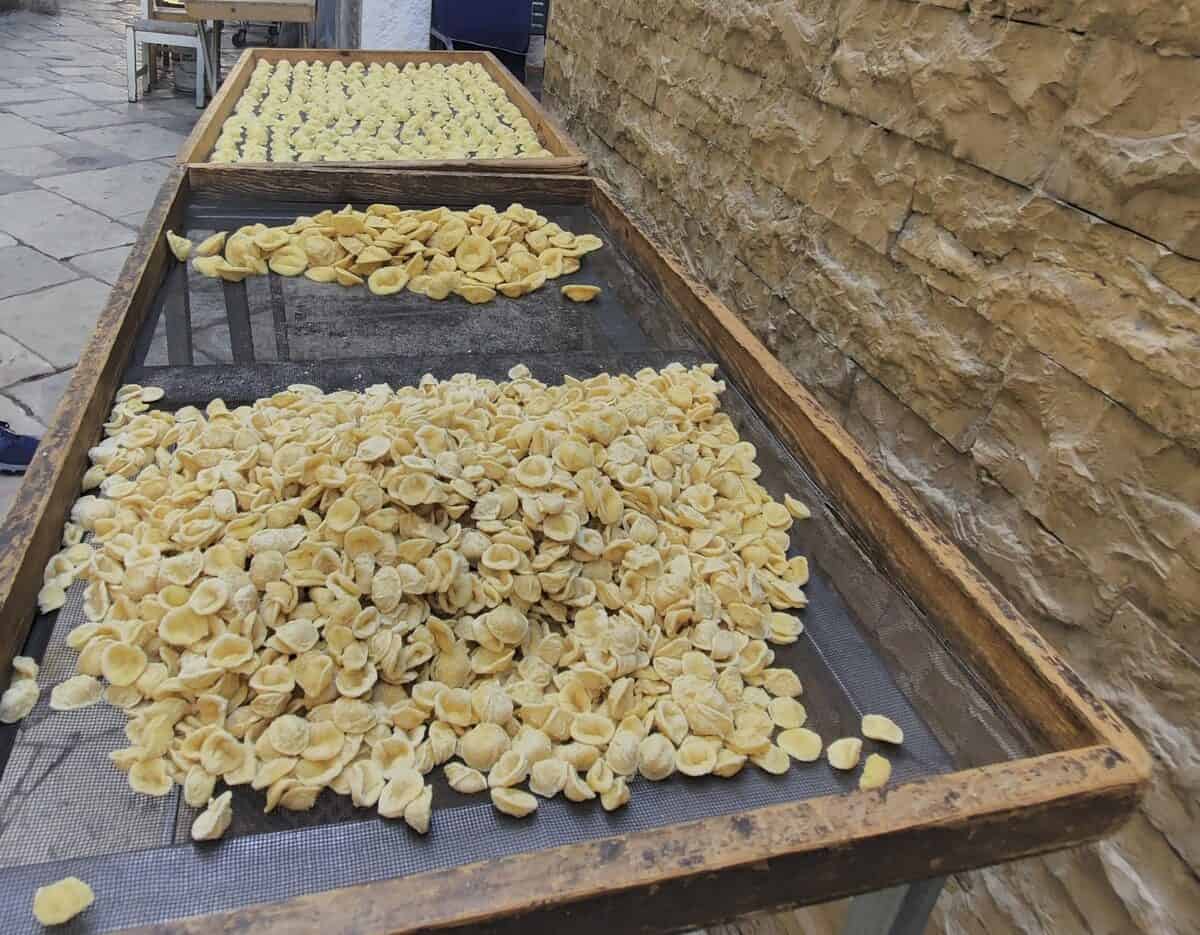
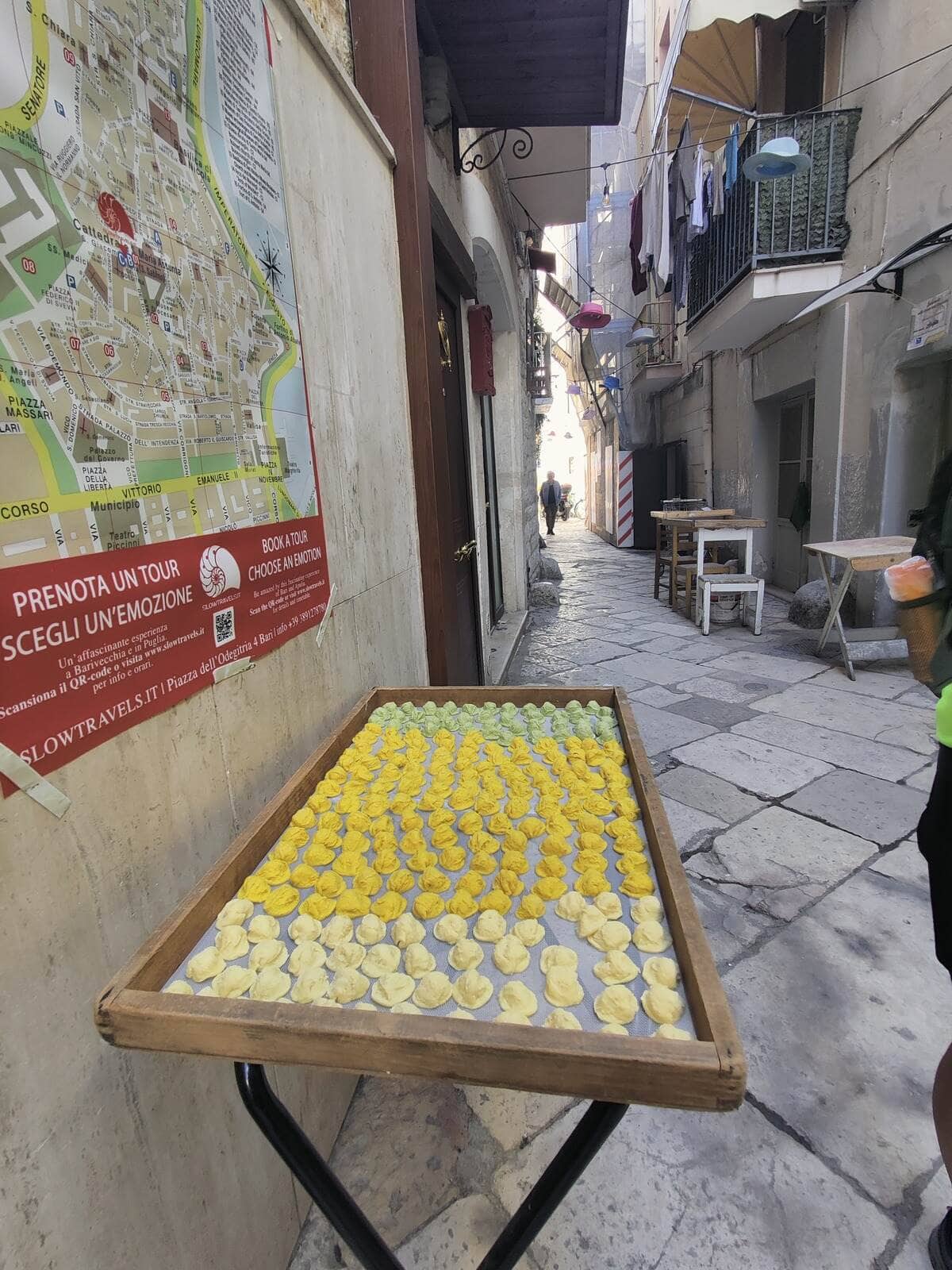
Each morning, you’ll see the street transform into an open-air workshop, with tables set up with wooden boards, miniature knives, and neat rows of orecchiette drying in the sunlight.
Without realizing it, the hotel I booked for my first night in Puglia, La Casa delle Tradizioni, was right on this stretch.
Arriving straight from the airport at 11 pm, I was confused why the street was full of long wooden tables spread randomly across the lane. The next morning, it made sense: those same tables were covered in flour and dough, with rows of orecchiette drying in the sun.
Most of the pasta grannies learned by watching their mothers or grandmothers in the same spot. Now, in their sixties or seventies, they still roll every day. Their pace is unhurried but constant, producing a few hundred pieces per hour, which are laid out to dry on wooden trays or screens.
Locals and tourists often stop to buy a small bag. About 300 grams is enough for dinner and costs a few euros.

How Orecchiette Is Eaten
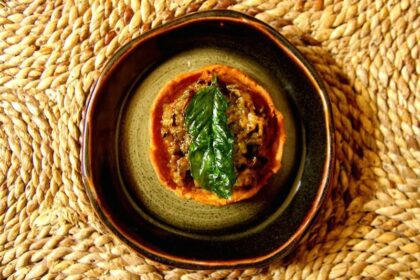
If you ask locals how to eat orecchiette, you’ll hear a host of answers, but the most traditional option is with cime di rapa—turnip-top greens cooked with garlic, anchovy, chili, and olive oil.
Other popular options are orecchiette al ragù or simpler versions like Orecchiette al pomodoro, bright with fresh basil in summer, or orecchiette alla crudaiola, a raw-tomato-and-ricotta mix when it’s too hot to turn on the stove.
Being vegetarian, I stuck to the plentiful vegetarian orecchiette options. Given it was summer, there were plenty of choices in Bari and most other towns in Puglia.
My personal favorite was the orecchiette al pomodoro, but I was surprised by how good the vegetarian version of the traditional cime di rapa was.
By the way, if you’re trying to eat vegan in Italy, traditional orecchiette is a great option since it doesn’t contain egg. Just double-check with your server before ordering.
Experiencing The Pasta Rolling Tradition As A Visitor
Where to find Orecchiette Street in Bari
Head to Arco Basso on Google Maps, often called Strada delle Orecchiette (Orecchiette Street), just off Piazza Mercantile in Bari’s Old Town, known as Bari Vecchia.
You’ll instantly know you’re on the right street because it looks much different from the other nearby lanes, with many tables laid outside that make the passage even narrower to walk through.
When to visit
Morning is best for the widest selection of pasta. The tables are typically set up as early as 8 am, so any time between 8 am and 12 pm is ideal. The street can get busy around lunch, but the summer heat often means fewer people after midday.
How to order orecchiette
Most pasta grannies understand English; nonetheless, buying a bag of orecchiette is a great way to practice Italian. Approach with a “Ciao” (hello) or “Buongiorno” (good day) first. If you’d like to buy, point to a ready bag and ask, “Quanto costa?” (How much does it cost?).
Where to try Orecchiette in Bari
Around Piazza Mercantile and Via Manfredi, you’ll find small trattorie (casual, homestyle Italian eateries) that serve fresh Orecchiette in Bari. Here are a few reliable options:
- La Bul. Go here for a more refined experience. The orecchiette are handmade and served in delicious pasta dishes that are best paired with one of their Italian wines.
- La Cantina dello Zio. This is a great eatery if you’re craving something hearty and homemade. Their orecchiette al ragù is known for its thick, rich sauce that feels like a family recipe.
- La Uascezze. Come here for atmosphere and tradition. It’s loud, local, and casual — with orecchiette served the way most Barese families make it, with a simple tomato sauce and strong cheese.
Tip: If you’re hunting for a good spot in the Old Town, look for hand-written boards. These places tend to have changing menus and often serve some of the best pasta in Bari.
Orecchiette Cooking Classes
If you want to learn and get more insight, join a small orecchiette cooking class run by the local women. They’re usually held in old houses or courtyards, with six to eight people.
You’ll roll, cook, and eat. It costs more than a bag from the street but gives you time to ask questions, get tips, and try your hand at shaping the pasta.
Preserving Tradition On Bari’s Orecchiette Street
Tourism has changed the street. Ten years ago, only locals bought pasta.
Now, groups stop here every day, phones out, cameras clicking. Some residents feel proud, and others feel a bit wary. Both can be true to some extent.
Buying the orecchiette allows you to support a local women-led business. Although this draws tourists and puts money into the local community, some of these women rightfully worry, wanting to be seen as cooks and not just photo ops.
As a result, you will see that a few doorways now have small handwritten signs saying “No Photos,” so make sure to ask before taking a picture and consider making a purchase.

How To Experience This Pasta Tradition Respectfully
Our local walking tour guide explained that the approach to buying pasta on Strada delle Orecchiette was to treat it like a home first, not an attraction. The women rolling pasta aren’t performers, but local people working their trade.
Building on this:
Ask before taking photos. Some women don’t mind; others do. A simple “Foto va bene?” goes a long way.
Buy if you stop to watch. It’s an easy way to show appreciation. A small paper bag costs just a few euros, and you’ll end up with a delicious and unique souvenir to take home.
Bring cash. There are no card readers here, at least when I went. If you don’t have cash, there are several ATMs near the entrance, in Piazza Mercantile, or on the main shopping street just outside Bari Vecchia, in the Murat district.
Don’t block the street. The street narrows as tables are set up, so during busy times, it can result in bottlenecks. Just be sure not to block the thoroughfare if you’re moving in a larger group.

Logistics For Visiting Orecchiette Street
Now that we’ve gone over what to expect and how to experience Bari’s pasta grannies, let’s go over some practical travel tips:
Getting there. From Bari Centrale station, walk about 15 minutes toward the sea. Once you enter the Old Town, follow the signs to Piazza Mercantile. Arco Basso is just beyond it.
When to go. The best time to visit Orecchiette Street is morning from 8 am onward. After lunch, the heat turns up and several shutters may close. Fridays are busier than other days, and Sundays are off days, so you will see fewer tables set up.
Where to stay. When deciding where to stay in Bari, choose somewhere easily accessible to Orecchiette Street, like La Casa delle Tradizioni.
Other things to do around Strada delle Orecchiette. Walk a few minutes to Basilica di San Nicola for a quiet pause, grab a coffee in Piazza Mercantile, then head to the lungomare for some sea views. Everything is pretty close by in Bari Vecchia.

FAQ About Bari’s Orecchiette Culture
To help further prepare you for visiting Orecchiette Street and eating this delicious pasta in Bari, let’s go over some frequently asked questions:
It’s fresh dough—just semolina and water—made every morning and usually sold within hours. To cook the pasta, boil it in well-salted water for 5 to 7 minutes until al dente.
Local kitchens offer cooking classes, which is a great way to learn how to make orecchiette from scratch. I recommend looking for a program with a small class size that focuses on technique. Local pasta makers run this focaccia and orecchiette cooking class, which is well rated for teaching authentic techniques.
Usually €3–5 for about 300 grams, which is enough for two plates. Have small notes or coins, as most sellers don’t keep change for large bills.
The traditional dish is called cime di rapa, turnip greens sautéed with garlic, anchovies, chili, and olive oil, with ricotta sometimes added as a finishing touch. Trust me, it tastes better than it sounds!
Orecchiette Street is busy Monday through Friday mornings, while Sundays are family days with fewer tables set up. In August, many local families leave the city, so the street is quieter.

Visiting Bari For Its Orecchiette: Final Thoughts
Watching the pasta grannies of Bari working away reminds me that food culture here lives in the everyday, not just in restaurants or cookbooks.
What makes Strada delle Orecchiette special is how naturally its traditions continue. If you’re visiting Bari, take time to walk through the Old Town in the morning and buy a bag of orecchiette.
You’ll quickly see why this simple pasta remains one of the most important symbols of Puglia!
Have you eaten orecchiette from the Pasta Grannies of Bari?